LDR3 Passive Preamp
Price: $1,195
This is a legacy product and is no longer produced or sold by Tortuga Audio.
| The original LDR3 was discontinued and replaced by the LDR3.V2. |
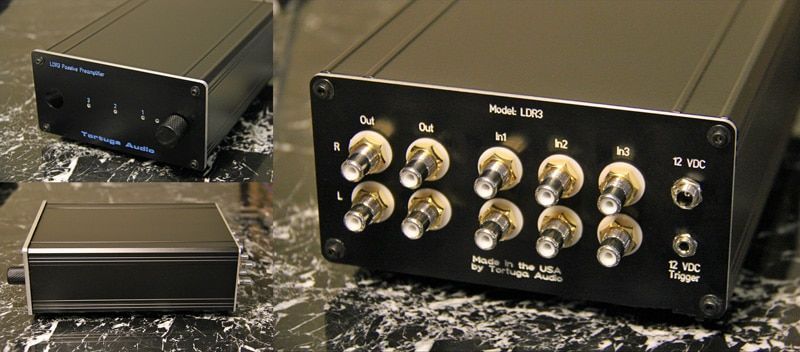
The LDR3 is a passive (unity gain) 3-input, 2-output preamp/volume controller, fully controllable via both a front panel control knob and a handheld remote (included). It’s part of Tortuga Audio’s LDRx family of passive preamps using digitally controlled, audio-grade LDRs for both volume control and line-stage input switching.
Improvements over the LDR1
Built on the same overall internal design and enclosure as its LDR1 predecessor, the LDR3 added:
New power regulator
A high performance internal switch-mode DC-DC power regulator providing cleaner power to the board — reported by beta testers to give a quieter, "darker" background between notes and better articulation of detail.
Cardas RCA jacks
Upgraded to Cardas GRFA-L jacks (retailing around $15.52 each; 10 of them per LDR3) — rhodium over silver plate over high quality brass.
Improved software
Key under-the-hood revisions improved the overall stability and reliability of the unit.
Subjective performance
Descriptive words and phrases commonly used by both customers and reviewers to describe the sound include: colorless, transparent, neutral, articulate, clear, fuzz-free, clean, natural, high resolution.
The consensus of customers and reviewers is performance superior to conventional passive preamps using even the best audiophile grade potentiometers, stepped resistive attenuators, or most transformer-based volume controls — and matching even the finest high-end preamps costing many thousands of dollars more.
Key features
-
Passive — no amplification of the audio signal. Most contemporary sources (DACs, CD players, phono stages) don’t need active pre-amplification before amplification.
-
High input impedance — maintains input impedance at or above 10k over the full attenuation range, for superior dynamics, fuller midrange, tighter bass, and satisfying percussive slam.
-
LDRs instead of potentiometers — LDRs combine a photoresistor with an LED into an integrated package; LDR resistance (and thus volume) is controlled by controlling the LED’s light intensity.
-
Digital control — a software-based, microprocessor-driven digital design with proprietary control software provides a precision-matched audio taper schedule while maintaining a nominal ~10k ohm input impedance.
-
No moving parts in the signal path — LDRs handle both volume control and input switching in lieu of relays or mechanical switches; nothing mechanical to corrode, fail, or degrade the signal.
-
Optically isolated signal path — the audio signal is optically isolated from the power supply and control circuitry, with electrical isolation between incoming signals in excess of 5 megaohms.
-
Flexible control — fully controllable via infrared handheld remote or the multi-function encoder/switch on the front panel; units shipped on or after November 1, 2013 also support the Apple Remote.