LDR300.V25 Buffered Preamp
Price: $1,495
This is a legacy product and is no longer produced or sold by Tortuga Audio.
| The solid state LDR300.V25 was discontinued as part of a renewed strategic focus on passive preamps and related tube-based buffers. |
The LDR300.V25 is a remote controlled, single-ended, solid state active preamplifier combining Tortuga Audio’s LDR attenuation technology with a robust JFET current amplifier (output buffer). It’s a unity-gain preamp without a gain stage — the "less is more" design philosophy applied to an active preamp. Comes equipped with a remote, external power supply, 3 inputs, and 2 parallel outputs using Cardas RCA jacks.
Elegantly simple signal path
The LDR300 combines the V25 preamp controller with a simple, highly effective solid-state JFET current amplifier (output buffer), while eliminating the unnecessary voltage amplifier (gain stage) in between. A 2-stage regulated split-voltage power supply removes the need for any input coupling capacitor, with the output running at near-zero volts DC offset.
No gain stage
Most of today’s line-stage source components (DACs, CD transports, phono preamps) don’t need the preamp to boost signal voltage for acceptable volume. The LDR300 takes advantage of that by avoiding the complexity, noise, and cost of a gain stage — less processing and manipulation of the audio signal for better sound.
Solid state buffered output
The Class A output stage is a robust current amplifier built around the ultra-low-noise LSK170 JFET, direct-coupled and running off a split-voltage power supply. The result is natural sounding audio with robust dynamics without the dryness sometimes associated with solid state gear. Impedance matching is never an issue, so longer interconnect cables and feeding both a main amp and subwoofer from the same output are both fine.
Low noise split voltage power supply
The LDR300 places the buffer’s JFET transistor almost exactly between the positive and negative power rails, where it operates near zero volts DC. Noise on the split rails largely cancels out, giving a very high power supply rejection ratio and an exceptionally deep, dark background. The positive and negative rails each use 2 series voltage regulators for a combined 100+ dB ripple rejection, with separate filter/bypass capacitors per channel per rail. Premium components throughout: Vishay/Dale resistors, Elna Silmic II filter capacitors, and Vishay polypropylene coupling capacitors in the signal path.
Optional output coupling capacitor upgrade
The stock polypropylene output coupling capacitor can be upgraded to a high performance V-Cap oil-impregnated metallized polypropylene capacitor.
Specifications
Preamp overview |
Single-ended, unity gain, remote controlled preamp with LDR attenuator and Class A solid state JFET buffer; 3 RCA inputs, 2 parallel RCA outputs. |
Attenuator type |
Digitally controlled, optically isolated LDRs in a 100-step two channel attenuator, two LDRs per channel in a series/shunt L-Pad configuration. |
Attenuation range |
-60 dB to 0 dB in 99 steps of ~0.6 dB, plus 1 additional muting step. |
LDR modules |
Each LDR is a compact, easily replaceable 4-pin socketed plug-in module. |
LDR calibration |
Software-driven calibration circuit calibrates each attenuation LDR over 99 steps to compensate for drift, aging, or replacement. Pre-matched LDRs not required. |
Gain |
None — nominally unity gain (no built-in signal/voltage amplification). |
Buffer type |
AC-coupled (input and output) JFET-based current amplifier running Class A at fixed current. |
Buffer module |
A separate small plug-in circuit board module per channel (2 total), mounted via a 4-pin header/socket, allowing alternative buffer components to be tried in the future. |
Input impedance |
Default 20k ohms; up to 9 additional configurable settings between 1k and 99k. |
Number of channels |
2 independent channels, typical stereo operation. |
Channel balance adjustment |
+/- 20 steps at ~0.6 dB per step (max +/- 12 dB) |
Channel balance accuracy |
Within 0.5 dB over the full attenuation range. |
Audio inputs |
3 switchable single-ended Cardas RCA stereo inputs. |
Signal switching/isolation |
All input/output switching via LDRs; no mechanical relays in the signal path. Isolation resistance in excess of 10 megaohms when off. |
Output isolation |
Output signals disconnected when powered down, muted, or during LDR calibration. |
Power supply |
US: nominal 12 VDC linear regulated "wall wart," 0.5 A. International: nominal 12 VDC switching "wall wart," 1.0 A |
Power regulation |
Attenuator: 2-stage regulation (5V switch-mode, then 3.3V linear). Buffer: standard low-current linear regulator (80+ dB ripple rejection), optional Belleson SuperRegulator (100+ dB). |
Control processor |
ARM M3 Cortex 32-bit microcontroller at 72 MHz |
Controls — remote |
Silver 7-button Apple infrared remote or equivalent (38 kHz NEC protocol) |
Controls — encoder |
Subset of controls via front panel rotary encoder with integral push-button switch |
Controls — display |
Graphic white-on-black OLED, interactive menu-driven interface built around the 7-button Apple remote |
Mono mode |
User can switch between stereo and mono via the remote. |
USB port |
Type A female, for firmware updates via PC bootloader application; cable provided |
Trigger out |
Outputs 12 VDC when the unit is powered on |
Enclosure |
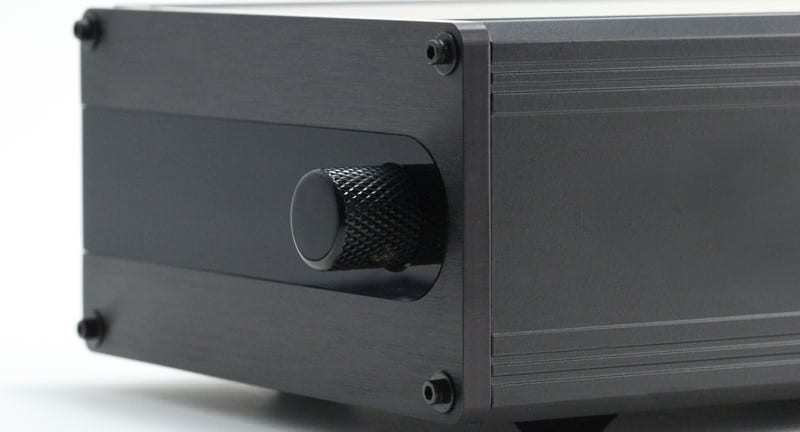
Heavy wall extruded aluminum case, black powder coat finish; brushed anodized aluminum front and rear panels; dark grey acrylic inlay in front of the display; laser-etched rear panel labeling; non-slip urethane feet |
Printed circuit board |
High quality nickel immersion gold solder PCBs with blue solder mask |
Solder |
Lead-free solder with 3% or higher silver content |
Fuses |
No internal or external fuses |
RoHS |
Compliant or exempted |
Ambient requirements |
Stable, dry indoor environment only, ambient temperature within 60-90 degrees F |
Dimensions |
~3.25" tall, ~6.0" wide, ~9.0" deep |
Weight |
~4.5 lbs; ~6 lbs as shipped |